.svg)

Beware the “Dangerous Other”
Discover how “dangerous others” can quietly damage your reputation, and how to protect your career before it’s too late.


In our professional lives we often have no control over the people we work with. Usually, through applying our own value set and making choices, we will formulate a close group of like-minded people we can trust and rely on. However, there may be other factors like corporate structures, incentives and “blind spots” that bring us into contact with people that can actually become destructive, and lead us into situations that result in reputational damage, lost opportunities and stress.
In this article I look into what I call the “dangerous other”, that figure who exerts such influence over us that leads others to perceive we are one and the same. We will see what to look out for, why it matters, and strategies we can take to protect ourselves.
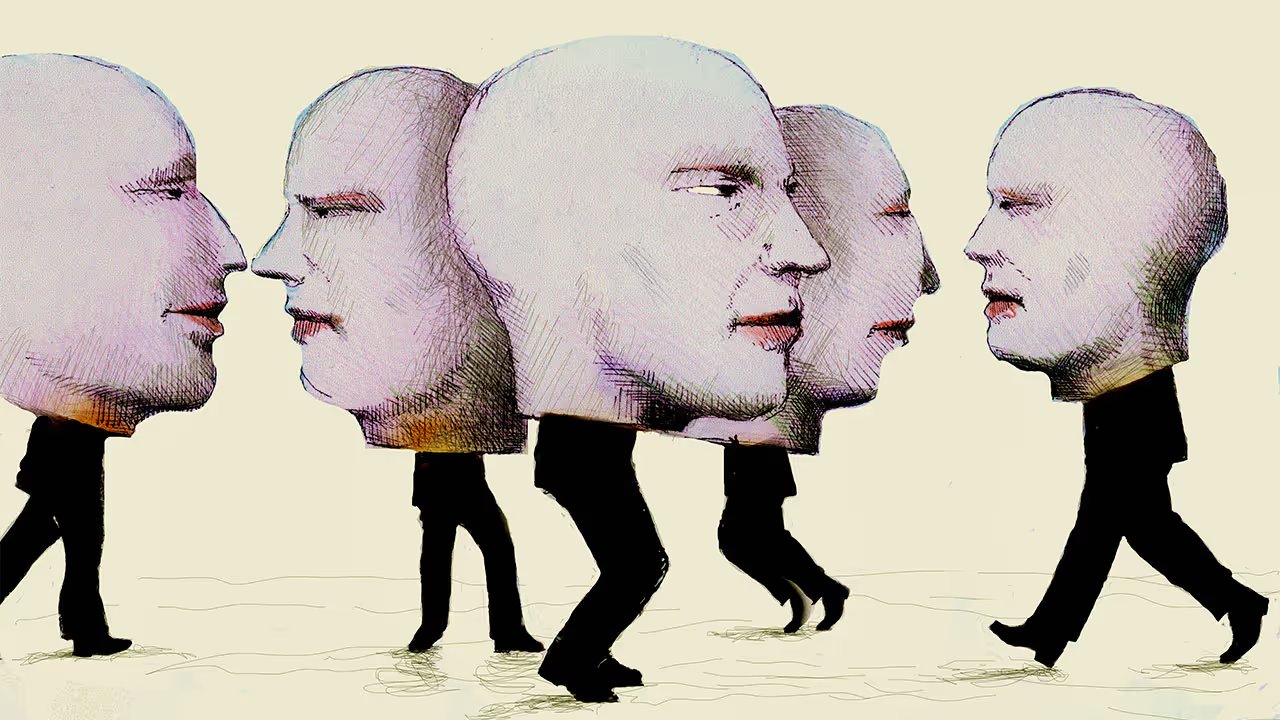
Jacob* had a lot going for him. He was smart, a good communicator, and young enough to seriously press for a CEO role in the future. He also had a close working relationship with his boss, Stuart*, the CEO of the public relations firm they both worked in. Jacob often spoke of a strong loyalty to Stuart, one that peers and clients could clearly see. Jacob saw Stuart as a mentor and friend, and believed that one day, when the timing was right, Stuart would anoint Jacob as his successor.
As time progressed, Stuart’s often blunt and hard-headed leadership style began to wear on people. His lack of concern for others, over-inflated sense of self-worth and managing the narrative of the day were notable trademarks. Jacob noticed this, but as that style very much differed from his own more measured style of leadership, he believed others would see that as a reason why it would make great sense for him to become Stuart’s successor.
Ultimately, when the firm’s board tired of Stuart, and decided not to renew his contract, a shock followed for Jacob. The board had hired an external CEO with an existing team of close, well-performed public relations executives. Jacob was given an option by the board – he could stay, but would need to take a step back and assimilate with the new leadership team, or he could accept a payout and look for another opportunity.
Stunned, he saw the latter as his best option. But as he reflected on events after leaving the firm, he kept coming back to an uncomfortable question: “Did the board really view me as one and the same as Stuart, when I had my own operating style, values and beliefs?”. In this case, they did.
“I really like you, but I just can’t vote for you because of your leader”
Sadly, Jacob is not alone in this situation. We have seen this occur in conservative politics in Australia, where several sitting Members of Parliament were told by their constituents before both the 2022 and 2025 federal elections, “I really like you, but I just can’t cast my vote for you because of your leader”. The Coalition has lost 45% of the seats it held when last in government, ending the political careers of many talented members and forcing a party rebuild from a crisis point.
WIn another example, a Human Resources manager was held personally liable and fined $7,500 for being “the very person who engaged in the unlawful conduct” when they dismissed a worker for a prohibited reason at the direction of their leader. Feeling no option other than to comply with instructions, it is now highly unlikely that person will ever work in Human Resources again.
Such examples shine a light on the impact the toxic behaviour of Dangerous Others can have. It can create career setbacks, loss of employment, stalled advancement, and in severe cases, exclusion from networks.
In my opinion, personal reputation risk is probably the most important risk we need to consider in our professional lives. We therefore need to stay extremely vigilant about the impact a Dangerous Other can have on that.
This goes beyond simply having a bad boss, or dealing with a difficult personality. What I’m talking about here are associations with others that may seem perfectly fine on the surface, or look like they could be extremely beneficial for a time, but ultimately lead to destructive results.
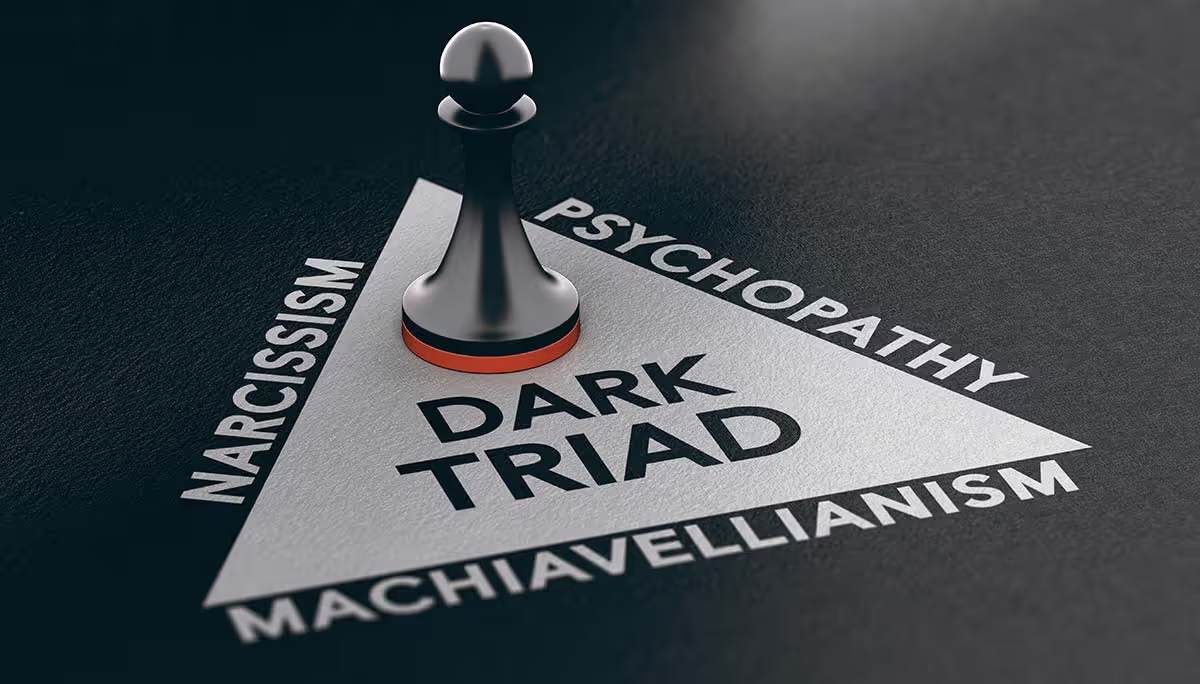
Leadership business Peter Berry Consultancy refers to the “dark triad” of personalities that are usually represented in Dangerous Others, associated with counter-productive and disruptive behaviour at work:
- Machiavellianism – a cynical view of human nature, where the belief is that manipulation is an effective and acceptable tool;
- Narcissism – an over-inflated sense of self-worth, a belief in their own superiority and craving for reinforcement;
- Psychopathology – a lack of concern for others, high impulsivity, and no remorse for causing harm.
These are all terms we have probably heard of at some stage. They might be more easily identifiable in extended family members or public figures, for example, than workplace settings due to the different dynamics at play. For that reasonit is worth spelling out more specifically the type of behaviour a Dangerous Other could employ:
- Toxic gossiping, undermining in front of others, competitive sabotage (or “white-anting”)
- Taking credit for the work of others, then using that to inflate their own contribution
- Shady ethics that drag others into trouble
- Over-dependant demands of time, attention and resources, at the expense of your own focus and reputation
- One that leverages your own network connections, without reciprocity
“There was a cost to him in being the beneficiary of the work of a Dangerous Other”
An obvious question emerges – if Dangerous Others are generally so destructive, how is it that they often succeed getting into positions of authority in so many fields?
Research conducted by Page, Bergner and Wills, published in the Harvard Business Review in 2017, focused on the quality of the relationship between leader and follower, and how similarity or difference in their personalities influenced this and leadership performance. They evaluated these concerns for each of the dark triad traits.
In their study, the researchers asked 350 middle managers (in this case “followers”, as they reported to a more senior leader) to rate their own dark triad traits, the quality of the relationship with their direct leader, and their leader’s dark triad traits and leadership performance. The research found that leaders can still form good quality working relationships despite having dark triad personality traits.
They put this significantly down to the personality of the follower. It makes sense when you think about it – similarity in leaders’ and followers’ dark personality characteristics, at least for narcissism and Machiavellianism, will produce better quality relationships. Not surprisingly, leaders high in psychopathy weren’t shown to be likely to form quality relationships with anyone.
Humans are wired to like or at least admire people that are like themselves. The researchers found the leader-follower personality match helps to buffer the negative impact of a leader’s dark traits on their work relationship. They gave an example of the cunning and manipulative ways of a Machiavellian personality being appreciated by their followers, especially if it results in them achieving joint goals. Perhaps this is what was occurring for Jacob. Stuart’s methods may have been helpful in clearing a path for Jacob to produce work that shone the spotlight on him and kept his trajectory on the up. However, the damage done in the background, unbeknown to Jacob, began to mount. There was a cost to him in being a beneficiary of the work of a Dangerous Other.
Humans are wired to like or at least admire people that are like themselves.
So how can we mitigate the impacts of the behaviour of dangerous others? While a time-consuming process, record-keeping is essential. Keeping notes of sensitive interactions, clarifying roles in writing, and limiting what you put your name to, unless completely comfortable, is recommended. This is particularly important with Machiavellians, who in my experience are strong at manipulating facts to suit their narrative and protect themselves.
It is always important to manage up and out, but especially so when led by a Dangerous Other. The probabilities are others in the organisation will know of your leaders’ behaviour. It is essential to seek advice from trusted others at multiple levels if you feel in a risky situation. In practice, when push comes to shove, this approach does not always guarantee a successful outcome, but it is better than suffering in silence. If nothing else, communicating concerns helps manage your mental health, and puts others clearly on notice about what is going on.
If the situation shows no sign of improving, planning a strategic exit to a different department or organisation is a way of gaining a level of control. This option will not be possible for everyone given different personal circumstances, however taking positive steps could lead to development of different networks, offer a boost in visibility, and bring more self-respect into the situation.
Above all, it is essential to remember the uncomfortable situations generated by Dangerous Others are almost always of their doing, not the follower.
The unfortunate part is their dark triad behaviour means blind spots are rarely acknowledged, and even if they are it is often too late to remedy. Followers are often left feeling vulnerable, and in their own minds wearing a significant part of the blame. Good career coaching, or counselling if the situation is more serious, are recommended in short order should those feelings exist.
Dangerous Others thrive on power imbalances. Their cunning, ego and impulsive behaviour is often used to achieve their professional ambitions. The way they dominate personal relationships is one part of that game. Remember, you have agency in managing your personal reputation. If something doesn’t look or feel right, reflect on why you think that is the case. In my experience, surrounding yourself with values-aligned professional operators is smart career insurance. Not only will that reduce the probability of falling into the web of a Dangerous Other, it will also offer up a network of voices that offer advice should those be taking a grip.
*Names have been changed to respect anonymity.
References
- Page, N., Bergner, S., Wills, S. “Who Empathizes with Machiavellian or Narcissistic Leaders?”. Harvard Business Review. 2017.
- DeFillippi, R., Arthur, M. “Journal of Organizational Behaviour”, 1994.
- Pearson, C., Porath, C. “Workplace Incivility”, 2005.
- Peter Berry Consultancy webinar: “Inside the best (and worst) teams – what really drives performance”. Presented by Morris, A. February 26, 2026.
About the author(s)