.svg)

The Architecture of Cultural Intelligence
Explore the practical skills of cultural intelligence that help you navigate complexity, connect meaningfully, and lead inclusively in a global workplace.


Scaling Technology Without Losing Human Connection
As technology enables us to connect faster, operate across wider networks, and scale seamlessly across markets, organizations continue to expand globally and hybrid work is becoming the norm. Yet technology has clear limits: digital reach does not equal human connection. In this high‑speed, borderless world, cultural intelligence equips leaders to bridge that gap with empathy, context, and clarity.
From New York to Singapore, stopping by London, teams now stretch across time zones, cultures, and languages. Technology has flattened distance and normalized remote work: meetings unfold through screens, decisions are made across continents, and strategies move at a pace that leaves little room for reflection.
Amid this transformation, technology has connected us more tightly, yet often at the expense of genuine human connection. The question is no longer how to connect employees, it is how to keep them connected meaningfully. No number of algorithms, chat platforms, or dashboards can, on their own, build trust, sustain motivation, or bridge the cultural gaps that shape global collaboration.
The paradox for executives? The more globally and remotely connected companies are, the more they need to connect their people.
This is the gap cultural intelligence (CQ) is designed to close, transforming digital reach into meaningful human connection. Born from the research of P. Christopher Earley and Soon Ang (2003), CQ describes the capability to function effectively across cultures. Two decades later, it has evolved from an academic construct into a practical discipline for global management. Leaders with high CQ do more than avoid cultural missteps, they build climates of inclusion, agility, and psychological safety that drive performance across markets.
This is the gap cultural intelligence (CQ) is designed to close, transforming digital reach into meaningful human connection.
What Cultural Intelligence Really Is, and Why It Matters Now
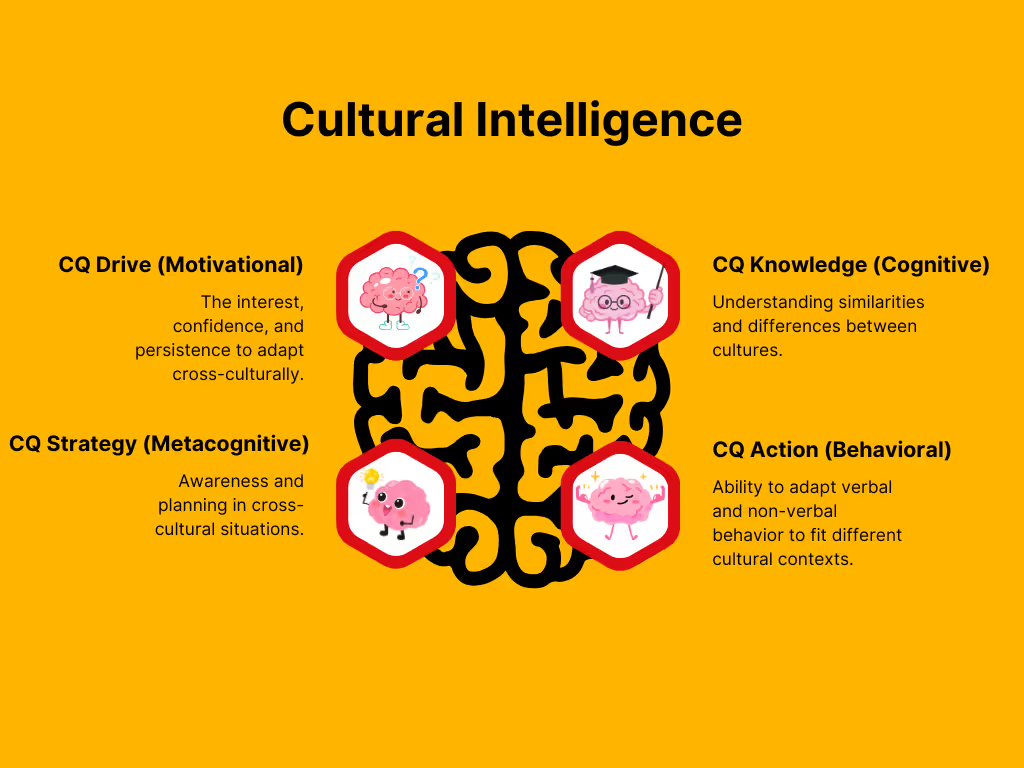
Cultural intelligence is not a single skill but a constellation of interrelated abilities that determine how effectively leaders interpret and act across cultural differences. The research of P. Christopher Earley and Soon Ang (2003) identifies four key dimensions : drive, knowledge, strategy, and action. Each dimension serves a purpose as shown in the diagram below:
In practice, these dimensions translate into seven competencies:
- Curiosity – an openness to learn from differences.
CQ begins with curiosity. The desire to explore, not judge, what feels unfamiliar.
- Self-awareness – understanding how one’s cultural background shapes perception.
Once curious, leaders turn inward to examine how their own assumptions color interpretation.
- Perspective-taking – viewing the world through another’s lens.
With self-awareness comes empathy. The capacity to imagine how others see and experience the same reality differently.
- Adaptive communication – adjusting tone, pace, and style to fit diverse contexts.
Perspective then becomes action: translating understanding into connection through flexible communication.
- Emotional regulation – sustaining composure amid ambiguity.
As differences surface, leaders maintain calm and curiosity instead of reacting defensively.
- Tolerance for ambiguity – remaining effective when norms are unclear.
Beyond composure, leaders learn to thrive in uncertainty, finding clarity in complexity.
- Inclusive judgment – integrating multiple viewpoints into balanced decisions.
Ultimately, CQ culminates in judgment. The ability to make fair, informed decisions that reflect diverse perspectives.
Each of these capabilities matters. Research consistently links these capabilities to measurable outcomes: higher team performance, stronger engagement, faster conflict resolution.¹
But for the purpose of this article, focused on how leaders can create meaningful connection in a globalized, tech-enabled world, we’ll focus on three that are especially critical: perspective-taking, adaptive communication, and tolerance for ambiguity. Together, they reflect how cultural intelligence shows up in practice: bridging distance, interpreting difference, and staying grounded amid complexity.
Perspective-Taking: Seeing Through Other Lenses
Perspective-taking is the heart of CQ, the ability to step outside one’s own frame of reference and see through another’s eyes. In global teams, this means questioning assumptions before interpreting behavior.
A late reply may signal disagreement in one culture, reflection in another. “Nodding a yes” may express respect, not consent. Leaders who practice perspective-taking choose to understand first and resist the temptation to interpret people’s behaviour through their cultural point of reference.
Microsoft, grappling with what it calls the “hybrid work paradox”, the tension between employees’ desire for flexibility and their simultaneous need for meaningful connection, has embedded cultural intelligence into its leadership approach. As part of this, global team leads are encouraged to “listen twice before deciding,” a pause that fosters cultural empathy in virtual interactions. In practice, this means giving space for silence, reading between the lines of digital communication, and checking assumptions before drawing conclusions. According to internal insights shared on Microsoft WorkLab (2023), this shift in mindset has contributed to a measurable increase in global team engagement and psychological safety.
Perspective-taking transforms awareness into empathy, and empathy into action. In a hybrid world where face time is scarce and signals are subtle, it becomes the bridge between connection and inclusion.
Leaders who practice perspective-taking choose to understand first and resist the temptation to interpret people’s behaviour through their cultural point of reference.
Adaptive Communication: Translating Without Losing Yourself
If perspective-taking is how leaders interpret others, adaptive communication is how they make themselves understood, clearly, respectfully, and without erasing who they are. It’s not about pleasing everyone; it’s about transmitting meaning across difference and meeting others where they are, without compromising core values.
In today’s distributed, multicultural work, the stakes are high. With fewer informal cues and less shared context, every message carries more risk of misinterpretation. What’s friendly to your American colleague may seem impolite for your manager in London; what’s efficient in one region might cause disruption in another. That’s why it is imperative to build clarity into communication, structuring messages with intent, simplicity, and cultural awareness.
At HSBC, where teams operate across more than 60 countries, communication is a core part of leadership development. Managers are trained to navigate cultural nuance by modifying tone and messaging style to fit regional expectations. For instance, while concise directives may work in London, leaders in Southeast Asia are encouraged to frame feedback more indirectly. As part of its inclusive leadership program, HSBC emphasizes “inclusive listening” and “intentional clarity”, helping global teams reduce misalignment and foster mutual respect across cultures (HSBC Global Inclusion Report, 2025)
It’s not about pleasing everyone; it’s about transmitting meaning across difference and meeting others where they are, without compromising core values.
Tolerance for Ambiguity: Staying Steady in the Grey
Hybrid work and global complexity introduce relentless uncertainty: multiple truths, incomplete data, and conflicting cultural norms. Tolerance for ambiguity is what enables leaders to stay grounded when clarity is absent. It’s not about indecision; it’s about holding space for complexity without panic, and exercising judgment amid fluid realities.
Leaders with high CQ don’t react impulsively. They pause, interpret signals across diverse contexts, and pivot when needed, without losing their center. This capacity to navigate ambiguity with calm is what keeps teams aligned when certainty isn’t an option.
According to Deloitte’s Global Human Capital Trends 2024, adaptability and comfort with uncertainty now rank among the top predictors of leadership effectiveness in transformation. Tolerance for ambiguity, the behavioral expression of adaptability, is what allows global teams to stay agile when norms collide and the pace of change outstrips the rules.
Leaders with high CQ don’t react impulsively. They pause, interpret signals across diverse contexts, and pivot when needed, without losing their center.
Cultural Intelligence as Agility
The future of leadership will not belong to those who know the most, but to those who can learn, unlearn, and relearn, a truth Alvin Toffler anticipated half a century ago. Cultural intelligence enables precisely that agility.
In environments defined by constant change, mergers, reorganisations, digital transformation, leaders face shifting norms and expectations. CQ trains the mind to interpret difference not as friction but as data, to pause before reacting, and to find meaning in ambiguity.
These three competencies, perspective-taking, adaptive communication, and tolerance for ambiguity translate into adapting a global mindset into daily practice.
In the end, CQ is not about mastering other cultures; it is about mastering the humility to learn from them. The leaders who will thrive in the years ahead are not those who master technology, but those who out-human it, connecting people, meaning, and purpose across every border technology can cross, but never truly bridge.
These three competencies, perspective-taking, adaptive communication, and tolerance for ambiguity translate into adapting a global mindset into daily practice.
References
- Earley, P.C. and Ang, S. (2003) Cultural Intelligence: Individual Interactions Across Cultures. Stanford, CA: Stanford Business Books.
- Deloitte (2024) 2024 Global Human Capital Trends: Thriving Beyond Boundaries – Human Performance in a Boundaryless World. Deloitte Insights. Available at: https://www2.deloitte.com/insights/global-human-capital-trends.html (Accessed: 13 December 2025).
- HSBC (2025) ‘Inclusion at HSBC’, Our People. HSBC Holdings plc. Available at: https://www.hsbc.com/who-we-are/our-people/inclusion-at-hsbc
About the author(s)