.svg)

Why Leadership Fails When Physiology Is Ignored
Explore why leadership isn’t just psychological. It’s biological, and how your nervous system shapes trust, performance, and team dynamics.


The Missing Human System in Leadership Theory
Leadership theory has evolved significantly over the past century. Scholars have examined traits, behaviors, contingency factors, charisma, emotional intelligence, transformational influence, and now a greater focus on followership as part of the leadership process. Each perspective has contributed valuable insights into how leaders mobilize people and shape organizational outcomes. Yet despite these advances, leadership failures continue to occur in organizations that otherwise appear structurally sound and well resourced.
One reason for this persistent break is that many leadership models assume that people respond primarily through rational cognitive processes. Leaders learn to communicate clearly, motivate effectively, and align organizational goals. However, most of these approaches often overlook a very basic and critical dimension of human interaction: physiology.
Human beings do not merely process leadership behavior intellectually; they also experience it biologically. Before a follower consciously evaluates a leader’s message or decision, their nervous system has already begun interpreting cues about safety or threat. When leadership theory ignores this physiological dimension, it risks misunderstanding why people respond the way they do in organizational settings.
Understanding the physiological foundations of interaction reveals why leadership sometimes fails despite competent strategies and well-intentioned communication. Leadership and followership are not measured in intentions, it is measured in behaviors, actions, performance and results. The human nervous system plays a central, very human, role in shaping how individuals interpret leadership behaviors, how trust forms, and whether collaboration emerges. Recognizing this biological layer does not diminish the importance of strategy or communication; rather, it sets the stage to explain why those tools succeed or fail in practice.
Human beings do not merely process leadership behavior intellectually; they also experience it biologically. Before a follower consciously evaluates a leader’s message or decision, their nervous system has already begun interpreting cues about safety or threat.
The Nervous System as an Interpreter of Safety or Threat in Leadership
Human interaction is deeply influenced by the autonomic nervous system, which regulates physiological states such as stress, calmness, and alertness. This system operates largely outside conscious awareness and constantly scans the environment for cues related to safety or danger (Porges, 2011). When individuals perceive safety, the parasympathetic branch of the autonomic nervous system supports calm engagement, allowing people to listen, collaborate, and think clearly. When threat is perceived, the sympathetic nervous system activates a stress response characterized by heightened vigilance, increased heart rate, and defensive behaviors.
Leadership interactions occur within this biological context. A leader’s tone, posture, facial expression, and emotional regulation all serve as signals that the nervous system interprets. These signals may convey reassurance and stability, or they may trigger subtle perceptions of risk. Importantly, this interpretation often occurs before conscious reasoning takes place. The brain’s threat-detection systems, particularly those associated with the amygdala, can activate physiological responses within milliseconds of detecting potentially negative cues (LeDoux, 2012). This occurs before you actually realize it.
This means that leadership communication is not simply a transfer of information. It is also a biological exchange of physiological signals. When leaders fail to recognize this reality, they may assume that resistance or disengagement is caused by lack of motivation or misunderstanding. In many cases, however, the underlying issue is physiological: followers’ nervous systems have interpreted the interaction as threatening or unsafe.
A leader’s tone, posture, facial expression, and emotional regulation all serve as signals that the nervous system interprets. These signals may convey reassurance and stability, or they may trigger subtle perceptions of risk.
Safety, Threat, and Organizational Behavior
The perception of safety plays a critical role in human cooperation. Research in psychology and neuroscience has demonstrated that individuals are more likely to engage in collaborative behavior when they feel psychologically secure within a group (Edmondson, 1999). Psychological safety allows individuals to express ideas, admit mistakes, and challenge assumptions and information without fear of social punishment.
Physiologically, psychological safety corresponds with a nervous system state that supports social engagement. According to polyvagal theory, the vagus nerve plays an important role in regulating this state by promoting calm attentiveness and interpersonal connection (Porges, 2011). When the vagal system supports a regulated state, individuals are better able to interpret social cues accurately and respond constructively.
Conversely, when individuals perceive threat within an interaction, physiological changes occur that can undermine effective collaboration. Stress hormones such as cortisol increase, preparing the body for defensive/protective action (Sapolsky, 2004). Cognitive resources shift toward threat monitoring rather than creative problem-solving. Under these conditions, followers may become cautious, withdrawn, or resistant, not necessarily because they disagree with the leader’s ideas, but because their nervous system has shifted into a protective state.
... followers may become cautious, withdrawn, or resistant, not necessarily because they disagree with the leader’s ideas, but because their nervous system has shifted into a protective state.
In organizational settings, these physiological responses can occur in subtle ways. A dismissive comment, abrupt tone, or poorly timed criticism may activate a follower’s threat response even if the leader did not intend harm. Because these signals operate at a biological level, the resulting behaviors, hesitation, disengagement, or defensiveness, can appear puzzling if physiology is not considered. A sample of some threat and safety signals, often subconscious, describe these behaviors.
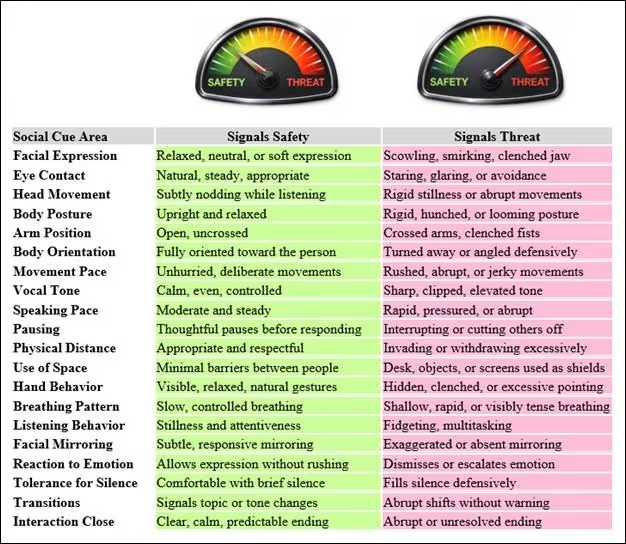
Diagram 1.0. Physiological Cues That Signa Safety or Threat – Dr. C. Fuzie, Ed.D.
The Role of Emotional Contagion
Another physiological dimension of leadership involves emotional contagion, the process by which individuals unconsciously synchronize their emotional states with others. Research suggests that humans possess neural mechanisms, often associated with mirror neuron systems, which allow them to detect and replicate the emotional expressions of those around them (Iacoboni, 2009).
In leadership contexts, this means that a leader’s emotional state can spread throughout a team. A calm, regulated leader can promote stability and confidence, whereas an anxious or agitated leader may inadvertently increase tension within the group. Emotional contagion operates through facial expressions, vocal tone, body language, and other nonverbal signals that the nervous system interprets rapidly.
This phenomenon highlights why a leader’s physiological state matters as much as leadership messaging. Two leaders may deliver identical instructions yet produce very different outcomes depending on their emotional regulation. Followers do not simply hear the words being spoken; they also absorb the emotional signals embedded within the interaction.
When leaders fail to regulate their own physiological state, especially during periods of stress or conflict, their behavior can trigger heightened anxiety among followers. Over time, this pattern can erode trust and reduce the team’s ability to function cohesively. Conversely, leaders who maintain a regulated presence can help stabilize the nervous systems of those around them, creating conditions that support collaboration and learning.
A leader’s emotional state can spread throughout a team. A calm, regulated leader can promote stability and confidence, whereas an anxious or agitated leader may inadvertently increase tension within the group.
Leadership and Co-Regulation
Human beings are inherently social creatures whose physiological states are influenced by other people around them. This process, known as co-regulation, occurs when individuals help stabilize each other’s emotional and physiological responses through interaction (Butler & Randall, 2013). In many ways, human relationships represent a form of ongoing co-regulation. This is something AI cannot do.
Leaders often set an emotional tone for their teams. During moments of uncertainty, followers look to leaders for cues about how to interpret the situation. If leaders demonstrate calm focus and constructive engagement, followers are more likely to mirror that stability. If leaders display frustration, fear, or hostility, those emotional signals can quickly cascade throughout the team or organization.
Co-regulation explains why leadership influence often extends beyond formal authority. A leader’s presence can shape the physiological environment of the workplace, affecting how individuals think, communicate, and collaborate. Recognizing this dynamic helps explain why effective leadership involves more than directing tasks or setting goals. It also involves managing the relational and emotional climate in which work occurs.
This insight points toward an important shift in how the leadership process should be understood. Rather than viewing leadership solely as a cognitive or strategic activity, it may be more accurate to see it as a dynamic interaction between nervous systems. Leadership effectiveness emerges not only from what leaders say or decide, but also from how their physiological presence influences others.
During moments of uncertainty, followers look to leaders for cues about how to interpret the situation. If leaders demonstrate calm focus and constructive engagement, followers are more likely to mirror that stability.
Synchrony in Leader–Follower Relationships
When leaders and followers interact within a regulated physiological environment, a phenomenon known as synchrony can emerge. Synchrony refers to the alignment of behaviors, emotions, and attention between individuals engaged in a shared interaction. Studies in social neuroscience have shown that synchronized interactions can produce measurable alignment in physiological indicators such as heart rate, neural activity, and emotional expression (Palumbo et al., 2017).
In leadership contexts, synchrony manifests as a sense of coordinated engagement. Conversations flow smoothly, ideas build upon one another, and participants feel mutually understood. Trust becomes easier to establish because individuals experience a shared sense of psychological safety.
Synchrony does not require perfect agreement or constant harmony. The paradox of synchrony is not uniformity. In fact, it thrives on differences.
The paradox is that the stronger the connection, the more diversity it can hold.
When physiology is ignored, however, synchrony becomes difficult to achieve or sustain. Misinterpreted signals, unmanaged stress responses, fractured trust, and emotional contagion can disrupt the alignment between leaders and followers. Over time, these disruptions can produce the kinds of leadership breakdowns that organizations often attribute to communication problems or personality conflicts.
Rethinking Leadership Through a Biological Lens
Recognizing the physiological dimension of leadership invites a broader reconsideration of how leadership is taught and practiced. Traditional leadership development programs often emphasize strategy, communication techniques, and decision-making frameworks. While these skills are essential, they may ignore or not fully address the biological processes that shape human interaction.
Integrating physiological awareness into leadership development could help bridge this gap. Leaders who understand how the nervous system interprets social signals may become more attentive to the relational impact of their behavior. They may recognize the importance of controlling the physiological cues, emotional regulation, tone, and timing in shaping follower responses. They may also become more skilled at recognizing when team members are experiencing stress responses that impair collaboration.
This perspective does not require leaders to become neuroscientists. Rather, it encourages them to appreciate that leadership occurs within a biological system designed for social connection and safety or threat detection. By aligning leadership practices with this reality, organizations can foster environments where trust, engagement, and collaboration are more likely to flourish.
Integrating physiological awareness into leadership development could help bridge this gap. Leaders who understand how the nervous system interprets social signals may become more attentive to the relational impact of their behavior.
Conclusion
Leadership failures often seem to stem from poor strategy, unclear communication, or lack of motivation among followers. While these factors can certainly play a role, they do not fully explain the complexity of biological, physiological, or social human interaction within organizations. Beneath every leadership exchange lies a biological system that continuously evaluates signals related to safety or threat, which develop or inhibit trust.
When leadership theory overlooks this physiological dimension, it risks misinterpreting the behaviors that emerge within teams and organizations. Followers may resist or disengage not because they reject a leader’s ideas, but because their nervous systems have interpreted the physiological cues as threat. Conversely, when leaders display physiological cues that display safety, it promotes co-regulation and a perception of safety, allowing collaboration to become more natural and resilient.
Understanding leadership through a physiological lens does not replace existing leadership theories. Instead, it continues to evolve the understanding of the leadership process by identifying how leaders and followers (all humans) connect physiologically. By revealing the biological mechanisms that influence how leadership behaviors are experienced and acknowledging the role of the nervous system in human interaction, leaders can cultivate environments where synchrony, trust, and effective collaboration are more likely to emerge.
Leadership, in this sense, is not simply about directing others toward a goal. It is also about shaping the physiological conditions in which people feel safety enough to connect, build trust and create synchrony in order to work together.
When leaders display physiological cues that display safety, it promotes co-regulation and a perception of safety, allowing collaboration to become more natural and resilient.
References
- Butler, E. A., & Randall, A. K. (2013). Emotional co-regulation in close relationships. Emotion Review, 5(2), 202–210. https://doi.org/10.1177/1754073912451630
- Edmondson, A. (1999). Psychological safety and learning behavior in work teams. Administrative Science Quarterly, 44(2), 350–383. https://doi.org/10.2307/2666999
- Iacoboni, M. (2009). Mirroring people: The science of empathy and how we connect with others. Picador.
- LeDoux, J. (2012). Rethinking the emotional brain. Neuron, 73(4), 653–676. https://doi.org/10.1016/j.neuron.2012.02.004
- Palumbo, R. V., Marraccini, M. E., Weyandt, L. L., Wilder-Smith, O., McGee, H. A., Liu, S., & Goodwin, M. S. (2017). Interpersonal autonomic physiology: A systematic review of the literature. Personality and Social Psychology Review, 21(2), 99–141. https://doi.org/10.1177/1088868316628405
- Porges, S. W. (2011). The polyvagal theory: Neurophysiological foundations of emotions, attachment, communication, and self-regulation. W. W. Norton.
- Sapolsky, R. M. (2004). Why zebras don’t get ulcers (3rd ed.). Holt Paperbacks.
About the author(s)